In this article25 min read
- The short answer
- Who is Ravana in the texts?
- The people around him
- The case that he was good
- The case that he was bad
- What the oldest texts actually say about “good and bad”
- Ravana in later retellings: the villain, the saint and the ancestor
- Ravana in the film: what Ramayana: Part 1 keeps and changes
- The curse theory: was Ravana’s villainy fated?
- How Ravana’s image changed, century by century
- How to read the Ravana question for yourself
- So, was Ravana a good man or a bad one?
Spoiler note: this page compares the Ravana of Nitesh Tiwari’s Ramayana: Part 1 (in cinemas since 5 November 2026) with the Ravana of the old texts. It mentions the film’s last act only briefly. The full ending is on our Part 1 ending explained page.
The short answer
Ravana is both, which is exactly why people have argued about him for two thousand years. In the epic’s own moral frame he is the villain: he abducts Sita, and no amount of learning, devotion or power excuses that. But the same tradition describes him as a scholar of the Vedas, a devotee of Shiva, a musician, a capable king and, in some texts, a physician. The old texts do not hide these qualities. They simply do not let them cancel the crime.
The film follows that line. Critics say Yash’s Ravana is the strongest part of Part 1, and the Hindu’s reviewer says the film gives the king of Lanka “fair treatment” while Rama sticks to tradition. But the film does not turn him into a hero. It shows his rise, his brilliance and his worship of Shiva, and then shows what he does with them.
Below we go through who Ravana is in the oldest texts, what the film changes and keeps, how other cultures remember him (as a villain, a saint, an ancestor, a future teacher), and how to read the question “good or bad?” without flattening it. It is long because the question is.
Who is Ravana in the texts?
His family: a sage’s son and a demon king’s grandson
In the Ramayana, Ravana is the eldest son of the sage Vishrava and Kaikasi. Vishrava is the son of Pulastya, one of the ten Prajapatis, the mind-born sons of Brahma, and one of the seven great sages. That makes Ravana’s paternal side Brahmin and about as distinguished as lineage gets.
His mother Kaikasi was the daughter of Sumali, a king of the rakshasas, who wanted a grandson as powerful as the best man alive and sent his daughter to find a husband among the sages. She chose Vishrava, the father of Kubera.
According to the account summarised on Wikipedia, Vishrava warned Kaikasi that their children would be rakshasas with cruel habits, and that only the last would take after him. The children were Ravana, Kumbhakarna and Shurpanakha, and finally Vibhishana, the virtuous one.
So the Ramayana sets up the question of nature versus choice inside one family, with Vibhishana as the brother who chooses dharma and Ravana as the one who does not.
The name itself is a clue. “Ravana” means “roaring”. Wikipedia notes it is paired with Vaishravana, Kubera’s name, which means roughly “one who hears” or is heard distinctly. Both are patronymics from Vishrava. One brother is the quiet god of wealth, the other the roaring king.
The ten heads
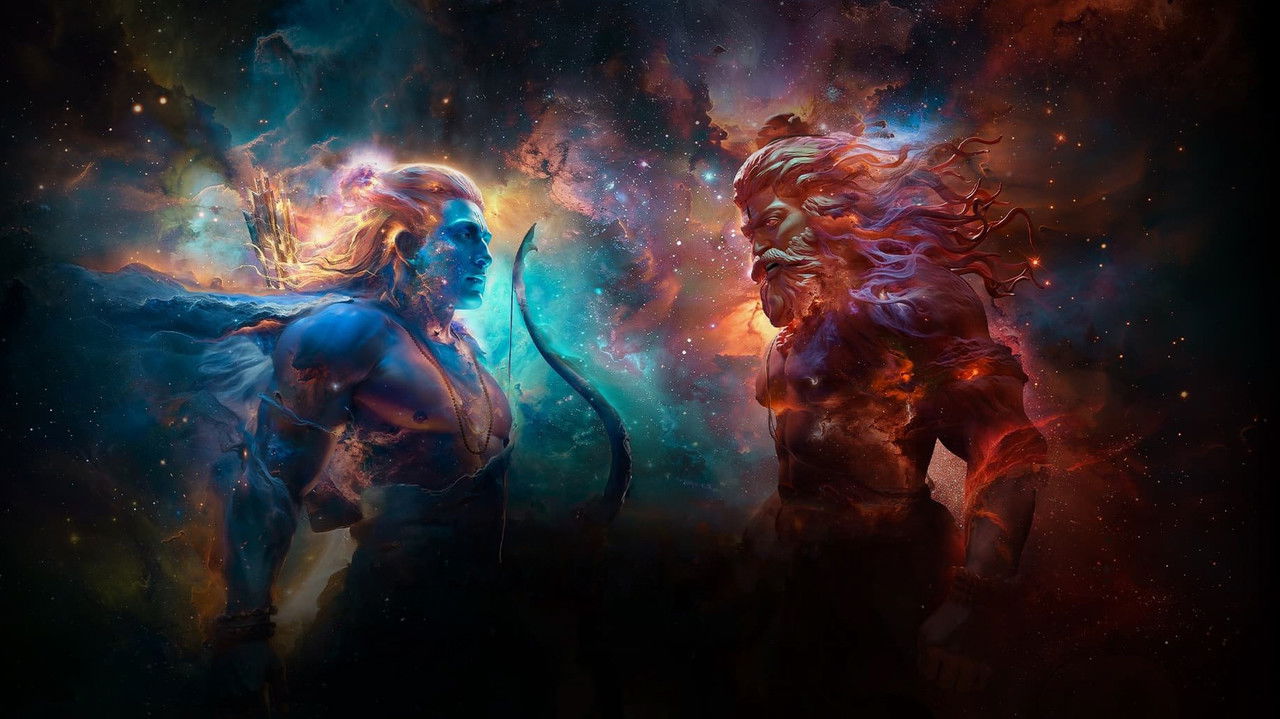
Ravana is depicted with ten heads, although he is sometimes shown with nine because, in one story, he cut one off to convince Shiva. His title Dashanana, “ten-faced”, means exactly that. Hindustan Times’s review of the film praises how the makers “interpreted the ten faces of Raavan”, which fits a long tradition of reading the heads as ten aspects of one personality (learning, pride, anger, desire, and so on).
The texts themselves are mostly interested in what the heads let him do rather than what they symbolise, so be wary of anyone who tells you the symbolism is the one correct reading.
The boon that explains the whole story
The most important fact about Ravana’s power is how he got it. He and his brothers Kumbhakarna and Vibhishana performed penance on Mount Gokarna for 10,000 years and won boons from Brahma. Ravana’s boon made him invincible to all of Brahma’s creations except humans. Brahma also gave him weapons, a chariot and the power to change shape.
Everything else follows from that omission. He did not ask to be safe from humans because he thought humans were beneath his notice. The gods, afraid of the harm he was doing, went to Brahma, and Vishnu promised to be born as a human to deal with him. That is why Rama exists in the story as a prince, not a god-king with an army of angels. Ravana’s confidence is the crack in his armour.
How he got Lanka
Lanka was first given to Kubera. Wikipedia’s account says Ravana and Kubera were half-brothers, that Ravana wrestled Kubera and defeated him for the Pushpaka Vimana (the flying chariot), and that Vishrava advised Kubera to give in to his half-brother’s demand to avoid a fight.
Kubera retired to Kailasa. This detail matters for the film. Hindustan Times’s review praises that the makers covered “how Raavan took over Kuber’s Lanka”, which tells you that Part 1 spends time on how Ravana became a king, not just what he did to Sita.
A king who took a city from his own brother is already a more complicated figure than a pure monster.
The people around him
You cannot judge a king without looking at his court, and Ravana’s court is one of the most interesting in the epic.
- Vibhishana is the youngest brother and the virtuous one. He advises Ravana to return Sita, is rejected, and eventually joins Rama. The Ramayana uses him to make a point: the same family, the same upbringing and the same boon-granting penance produced a man who chose dharma. It makes Ravana’s choices his own and not simply his birth.
- Kumbhakarna is the giant brother, who in the tradition sleeps for months at a time. In the Bhagavata Purana tradition he is the other reincarnation of the cursed doorkeeper. He is often remembered for fighting for his brother even while thinking the cause unjust, which is why many readers find him more tragic than Ravana himself.
- Shurpanakha is the sister whose humiliation sets the abduction in motion in the film and the epic. In the film she is played by Rakul Preet Singh, and DNA says she “looks beautifully vicious”.
- Mandodari is his chief queen, the daughter of the divine architect Maya. In the retellings she is often the voice of reason who warns him. In the Thai Ramakien she is also the mother of Sita.
- Meghnad (Indrajit) is his eldest son and crown prince of Lanka. Other sons listed in the Ramayana include Atikaya, Akshayakumara, Narantaka, Devantaka and Trishira. Meghnad is glimpsed in the film’s post-credit scene, played by Raghav Juyal.
- Malyavan is his granduncle, who opposed the war with Rama and Lakshmana. Like Vibhishana and Mandodari, he is one more voice Ravana does not heed.
- The generals. His maternal uncles Dhumraksha, Prahastha, Akampana, Vajramushti, Suparshwa and Virupaksha were generals in the Lanka army, according to Wikipedia, and his cousins Khara and Dushana governed the territories of Janasthana, the forest region where Rama lived in exile. That detail matters: the Dandaka forest is not empty wilderness in the epic. It is a border region of Ravana’s world, which is why his family’s presence there leads to conflict with the exiles.
Taken together, this is a king surrounded by people who know him well, and several of them tell him he is wrong. The Ramayana’s real indictment is not that Ravana was surrounded by yes-men. It is that he was surrounded by honest advisers and chose not to listen.
The case that he was good
If you want to argue Ravana was a great man, the texts give you plenty to work with. None of the following is a modern invention. Most of it is in the tradition itself.
- He was a scholar. He is described as versed in the four Vedas and the six shastras, and a great student of his father Vishrava, who taught him tapasya, yajna and the Vedas.
- He was a devotee of Shiva. Images of Ravana appear with Shiva in temples. A famous image called Ravananugraha, popular in the Gupta era, shows Ravana beneath Mount Kailash playing a veena made from his own head, arms and tendons while Shiva and Parvati sit above. In the popular story he tried to lift Kailash, Shiva pressed the mountain down on him, and he sang the Shiva Tandava Stotra for a thousand years until Shiva was pleased and gave him a sword and an Atmalinga. Wikipedia notes that this incident has little or no support in Valmiki’s text, so it belongs to later tradition, but the devotion itself is old and widespread.
- He was a musician. The veena is his instrument, and the ravanahatha, a bowed string instrument still used in Rajasthani folk music, is traditionally said to be his invention.
- He is credited with science. The Ravana Samhita, a book on astrology, is attributed to him. In the Ayurvedic tradition he is named a pioneer of pharmaceutical science and credited with the Arka Prakasha, a Sanskrit text on distillation. Treat these as attributions of later tradition, not proof he wrote them. They show how highly later writers wanted to honour him.
- He was a capable ruler. He had the loyalty of an army, a council of relatives and ministers, and, in the Sundara Kanda, a city so splendid that Hanuman is awed by it. (Retellings of this scene commonly have Hanuman admiring Ravana’s court and regretting that such a figure walked away from dharma. We mention it as a retelling and not as a quotation from the Sanskrit.)
- He respected his family and kept to a code, in places. The curse of Nalakuvara (below) explains why he could not touch Sita without her consent. Some readings say this is also why he housed her in a garden and not in his palace. Others read it purely as a plot device.
This is the Ravana of the Dravidian-movement poem Ravana Kaaviyam by Pulavar Kuzhanthai, a panegyric of 3,100 stanzas that made Ravana its hero. It was released in 1946, subsequently banned by the Congress-led government, and the ban was lifted in 1971. It is the Ravana of the novels Asura: Tale of the Vanquished by Anand Neelakantan (2012) and Raavan: Enemy of Aryavarta by Amish Tripathi (2019). And it is the Ravana of the worshippers in towns like Bisrakh, near Greater Noida, which claims to be his birthplace, and the temples in Kanpur, Kakinada, Mandore near Jodhpur, Vidisha and elsewhere.
The case that he was bad
Now the other side, which is also in the tradition. The episodes below mostly come from the Uttara Kanda, the last book of the Valmiki Ramayana. Scholars treat the first book (Bala Kanda) and the last (Uttara Kanda) as later additions to the older core of books two to six, so these stories are in the epic as it has come down to us, but are a later layer than the main war story.
- The abduction of Sita. The central fact. In the epic, he takes a woman by deceit from her husband’s home, in his brother’s flying chariot, and holds her captive in Lanka’s Ashoka garden. It is the act that defines him and the one the film ends on.
- Vedavati. According to the Ramayana story summarised on Wikipedia, Ravana found Vedavati meditating, was captivated by her beauty, proposed marriage and was refused. When he persisted, he grabbed her hair and tried to assault her. She cursed that she would be reborn and be the cause of his death, and walked into the sacrificial fire. In the tradition Vedavati is the earlier birth of Sita. In other words, the abduction of Sita is not Ravana’s first offence against the same woman.
- Rambha. The tradition says Ravana forced himself on the apsara Rambha even after she told him she was like a daughter-in-law to him (she was the wife of Nalakuvara, son of Kubera). Nalakuvara cursed Ravana that if he ever forced a woman who did not consent, his head would split into pieces. That curse is the classical explanation for why Sita is not violated in Lanka. It makes Sita’s safety a matter of a curse, not of Ravana’s restraint, which is a reading that does not flatter him.
- The killing of Anaranya. Ravana killed Anaranya, king of Ayodhya, who with his dying breath cursed Ravana to be slain by a descendant of his own line, which is Rama’s.
- Conquest and violence. He subdued and harassed the gods, fought the Nivatakavacha demons for a year until Brahma stopped the war, and caused so much trouble on earth that the gods begged for help. The Ramayana’s own premise is that he had to be stopped.
- Over a thousand wives. The Sundara Kanda tells us he had over a thousand wives, with Mandodari, the daughter of the divine architect Maya, as chief queen. Modern readers may find this less offensive or more, depending on how they read power and consent in that setting. At the least, it shows how the text thinks of him: a man whose desires are as big as his ambitions.
- Pride that refuses counsel. The Ramayana lets him be warned by nearly everyone: his brother Vibhishana, his granduncle Malyavan, his wife Mandodari. He refuses all of them. The tradition keeps returning to this because it is the real tragedy of the character: he is intelligent enough to know better.
What the oldest texts actually say about “good and bad”
It helps to be precise about what source we mean. Scholars estimate that the primary oral stage of the Valmiki Ramayana dates to roughly the 8th–5th to 5th–4th century BCE, with later stages extending up to the 3rd century CE. It has over 24,000 shlokas in seven kandas.
Books two to six are the oldest part. So the Ravana we meet in the war books (Aranya, Kishkindha, Sundara, Yuddha) is the older Ravana: the king of Lanka who abducts Sita, refuses to return her, and is killed in war. Most of the rich backstory (Vedavati, Rambha, the Kubera conquest, the Brahma boon told at length) sits in the Uttara Kanda or in later retellings.
That does not make the backstory “fake”. It means the Ravana we know is a layered figure, built up over centuries by many writers, each deciding how much sympathy or horror he deserved. The question “was Ravana good or bad?” really has several answers depending on which layer you read.
One more point from the tradition. In the telling of the epic’s end, Rama asks Vibhishana to perform Ravana’s funeral rites and says that enmity ends with death. (This is how the scene is widely told; check a translation of the Yuddha Kanda if you want the exact wording.) The hero of the story does not demand that Ravana be remembered only as a monster.
Ravana in later retellings: the villain, the saint and the ancestor
The Ramayana travelled across Asia and changed as it went. Ravana changes with it.
Kamban’s Tamil Ramayana
Kamban, a Tamil poet of the 12th century who grew up in the Chola empire, wrote the Ramavataram, popularly called the Kambaramayanam, in around 11,000 stanzas. It is one of the great retellings in an Indian language, and Wikipedia notes that references to the Ramayana story appear in Tamil literature as early as the 3rd century CE. We mention it because it shows that Ravana has been retold, debated and reimagined by poets for many centuries, not only by modern writers.
Tulsidas and the devotional Ramayana
The Ramcharitmanas of Tulsidas (1576), written in Awadhi, is a bhakti retelling. It gives Ravana his stature, but its focus is devotion to Rama, and in it Sita is under the protection of Agni (Maya Sita) while Ravana takes only an illusion. That change matters. It means the Ravana of this version never truly touches the real Sita.
Jain Ramayanas
In the Jain tradition, both Rama and Ravana are devout Jains. Ravana is a Vidyadhara king with magical powers, and in the Jain accounts it is Lakshmana, not Rama, who kills him, because Rama, a liberated soul in his last life, would not kill. The earliest known Jain version is the Paumachariyam of the monk Vimalasuri, written in Maharashtri Prakrit. According to the Jain texts summarised on Wikipedia, Ravana is destined to be a future Tirthankara, an omniscient teacher. Think about what that means: one of the most hated figures in one tradition is a future saint in another.
Buddhist and South-East Asian versions
Ravana also appears in Buddhist literature, including the Mahayana Lankavatara Sutra. In the Thai Ramakien, he is Thotsakan, a ten-necked rakshasa shown with green skin, and Sita is his daughter with Mandodari (Montho). In the Cambodian Preah Ream he is a rakshasa, and in the Laotian Phra Lak Phra Lam he is a materialistic Brahmin. The Javanese Kakawin Ramayana, believed to date from around 870 AD, is based not on Valmiki but on the Sanskrit poem Bhattikavya (Ravanavadha, the “Killing of Ravana”). In Indonesia, the Ramayana is told in wayang shadow puppetry and in Balinese and Javanese dance drama, where Ravana is a major, vividly drawn presence.
Ravana as ancestor and god
Some communities claim him as their own. The Gond people of central India say Ravana was an ancient Gond king and teacher and keep temples for him, his wife Mandodari and his son Meghnad. The Sachora Brahmins of Gujarat claim descent from him. Saraswat Brahmins of Mathura claim him as one of their lineage.
The Dashanan Temple in Kanpur opens only once a year, on Dussehra, so worshippers can pray for his welfare, on the very day effigies of him are burned elsewhere.
That last detail, effigies on one side of the country and a temple opening in his honour on the same day, is the whole argument in miniature.
Ravana in the film: what Ramayana: Part 1 keeps and changes
Now the movie. Part 1 is directed by Nitesh Tiwari, co-written with Shridhar Raghavan, and based on Valmiki’s epic. Yash, in his Hindi film debut, plays Ravana, and he also co-produces. The film was released worldwide on 5 November 2026. Here is how the Ravana of the film compares with the Ravana of the page, based on reviews and reported plot points.
What the film keeps
- The rise. Part 1 is built around the rise of Ravana as well as Rama’s life, according to India Today. Hindustan Times’s review says the makers cover the basics properly, naming how Ravana took over Kubera’s Lanka and his devotion to Shiva.
- The ten faces. Hindustan Times says the makers interpreted the “ten faces of Raavan brilliantly”. The film does not hide the iconography.
- Shurpanakha’s humiliation as the trigger. Reports on the last act say that after Lakshmana humiliates Shurpanakha (played by Rakul Preet Singh), Ravana decides to take revenge on Rama through Sita. That follows the epic’s structure.
- The golden deer and the false cry. Maricha (Saurabh Sachdeva) takes the form of a golden deer, Rama goes after it, Maricha imitates Rama’s cry for help, Lakshmana leaves Sita after drawing a protective line, and Ravana, disguised as a beggar, tricks her over the line.
- The Pushpak Vimana. Ravana takes Sita in the flying chariot. The Guardian’s reviewer, Peter Bradshaw, calls the machine “Gilliamesque”, a nod to the director Terry Gilliam’s fantastical designs, and notes that Ravana “does not have the ability to fly as such”. That is a nice detail: his power is borrowed from the brother he beat.
- The final emotional note. After Jatayu dies, Rama vows to kill Ravana before all three worlds, per India Today.
What the film changes or emphasises
- Ravana is the most vivid character. DNA calls Yash’s portrayal “the biggest driving force of the narrative”. Hindustan Times says Yash “owns” Part 1. NDTV says Yash goes all out to embody “the destructive and invincible force” Ravana represents. The Hindu’s headline puts it more simply: Ravana outshines Rama on screen.
- Sympathy, but not a rewrite. IGN’s reviewer says the film “comes close to engendering sympathy” for Ravana but sticks too closely to traditional notions of light and darkness to depart from the poem. The Hindu says Lankesh gets fair treatment while Rama sticks to tradition. Mint’s critic found the film too cautious overall. In other words, the film gives Ravana room to be impressive and charming, and still does not argue that the abduction was right.
- Jatayu’s fight as a moral contrast. India Today says Jatayu is a warrior who damages Ravana’s chariot and nearly wins. The scene puts a clear moral contrast on screen: Ravana’s strength is used for conquest, Jatayu’s for protection. Many reviews call it the film’s highlight.
- The music. The second single, “Ravana Tandav”, was released on 20 October 2026, Dussehra, which tells you how central the character is to the film’s marketing. The title points to the Shiva Tandava Stotra tradition, which links him to his devotion.
What critics say about the Ravana question
The film’s Ravana is one of the few things nearly all reviews agree on, even where they disagree about the rest. The Critic Score for the film on this site is built from the critics listed on the Ramayana reviews page. Some reviewers wanted more depth from every character. NDTV, for example, felt the familiar characters were flat. Scroll’s reviewer praised a vivid Raavan while finding the Ram-Sita romance dull. The Telegraph’s headline credits Yash with stealing the show. If you only remember one critical point, it is that audiences are likely to leave talking about Ravana.
That is not a new thing. The most memorable villains in epic storytelling tend to be the best written. But there is a reason this particular villain has so many defenders.
The curse theory: was Ravana’s villainy fated?
There is a third way to read Ravana that is neither “good” nor “bad”. In the Bhagavata Purana, Ravana and his brother Kumbhakarna are reincarnations of Jaya and Vijaya, the two gatekeepers of Vaikuntha, the home of Vishnu. They turned away a group of sages (the Sanat Kumaras, who looked like young children because of their austerities), and the sages cursed them to be born on earth.
Vishnu agreed that they should be punished and offered two options: be born seven times as ordinary mortals who love Vishnu, or be born three times as powerful beings who are his enemies. Eager to return to him quickly, they chose the second.
The Purana’s accounting is neat. The first birth is Hiranyaksha and Hiranyakashipu in the Satya Yuga, killed by Varaha and Narasimha. The second is Ravana and Kumbhakarna in the Treta Yuga, killed by Rama. The third is Dantavakra and Shishupala in the Dvapara Yuga, killed by Krishna.
If you read Ravana this way, his hostility to Vishnu is a path back to the god and not a final rejection of him. It also means you cannot call him simply evil without also calling the whole cosmic arrangement strange. This is a later Puranic idea and not part of Valmiki’s core story, but it is one of the reasons many devotees speak of Ravana with a kind of reluctant respect even while celebrating his defeat.
It is also the reading most at odds with the simple “good man versus bad man” frame films usually prefer.
How Ravana’s image changed, century by century
Here is a rough timeline, built from the dates in the sources above. Treat early dates as scholarly estimates.
- About 8th–4th century BCE: the primary oral stage of the Valmiki Ramayana, according to scholarly estimates, with later layers extending to about the 3rd century CE. The war books carry the older, tougher Ravana. The early and late books add backstory.
- By around the 3rd century CE: references to the Ramayana story appear in Tamil literature, per Wikipedia.
- Around the 4th century CE and after: Jain tellings, such as the Vasudevahindi and Vimalasuri’s Paumachariyam, give a very different Ravana, a Jain Vidyadhara king and future Tirthankara.
- Gupta era: the Ravananugraha image, Ravana beneath Kailash playing the veena, becomes a popular sculpture, which shows how strongly his Shiva devotion was already part of his image.
- 6th–7th century: the Sanskrit poem Bhattikavya, also called the Ravanavadha, retells the story, and later inspires the Javanese Kakawin Ramayana (believed to date from about 870 AD).
- 12th century: Kamban’s Tamil Ramavataram.
- 1576: Tulsidas’s Ramcharitmanas, a devotional telling in Awadhi, the version many North Indian households know best.
- 1938 onwards: the film Bhakta Ravana (1938) and its Telugu and Kannada remakes put Ravana at the centre of cinema.
- 1946: Pulavar Kuzhanthai’s Ravana Kaaviyam, which was later banned and then allowed again in 1971.
- 2010: the Tamil film Raavanan and its Hindi counterpart Raavan retell the story from Ravana’s side in a modern setting.
- 2012 and 2019: Anand Neelakantan’s Asura and Amish Tripathi’s Raavan: Enemy of Aryavarta.
- 2026: Ramayana: Part 1, which critics say makes Ravana its engine while keeping him a villain.
Notice the pattern. Every few centuries, a storyteller asks what the epic would look like if we paid attention to the other side. The question does not weaken the epic. It is part of why it survives.
How to read the Ravana question for yourself
- Start with the main war books (Aranya, Kishkindha, Sundara, Yuddha) of a good translation of Valmiki. That is the oldest layer and gives you the baseline Ravana.
- Read the Uttara Kanda for the backstory, and keep in mind that scholars see it as a later layer.
- Compare one devotional retelling (Tulsidas), one poetic retelling (Kamban) and one non-Hindu retelling (the Jain Paumachariyam or the Thai Ramakien).
- Then watch the film, and ask where it keeps to the old frame and where it gives Ravana room.
So, was Ravana a good man or a bad one?
Here is a fair way to answer it.
1. In the epic’s moral frame, he is wrong
The Ramayana is a story about dharma, duty and consequences. Ravana breaks dharma in a way the story treats as unforgivable: he steals another man’s wife through deceit and holds her prisoner, ignores the pleas of his family and ministers, and sends his kingdom to war for his pride. That is the verdict of the text, and the film respects it.
2. But the epic does not pretend he is a cartoon
The same tradition gives him a learned father, a Brahmin lineage, a famous devotion to Shiva, a veena, a wise queen and a loyal city. It keeps telling us what a gifted man he is, because the tragedy only works if we see what he throws away. A villain with nothing admirable in him teaches us nothing. A villain whose gifts are real is a warning.
3. His “goodness” has been used to say different things
- For his devotees, he proves that devotion and learning are not enough. Character is the test.
- For the Dravidian-movement writers who made him a hero, he was a symbol of a culture that they felt the mainstream story had written as the enemy.
- For Jains, he is a being who will one day become a teacher, so his current story is only one chapter.
- For modern novelists, he is a man who might have been right about some things and still wrong about the thing that matters.
4. Sensitivity matters
Millions of people worship Rama and Sita, and for them the burning of Ravana’s effigy on Dussehra is an act of devotion. Millions of others honour Ravana as a great devotee or ancestor. Both exist in India today, often within a few hundred kilometres of each other. This page does not ask you to pick a side. It asks you to see why the question is hard.
Movie vs book: a quick comparison table in words
- Origin: Book: son of the sage Vishrava and the rakshasa princess Kaikasi. Film: the Ravana of Part 1 follows the epic, with his rise and Shiva devotion covered, per Hindustan Times.
- Lanka: Book: first Kubera’s, taken by Ravana. Film: the takeover of Kubera’s Lanka is shown, per Hindustan Times.
- Power: Book: boon from Brahma, invincible to everything but humans. Film: the film frames him as an “invincible force” (NDTV). The boon’s exact treatment on screen has not been described in the reviews we have read.
- Motive for the abduction: Book: revenge for Shurpanakha’s humiliation and desire for Sita, with other readings in other versions. Film: revenge for Shurpanakha’s humiliation is shown in reports.
- Method: Both: Maricha as the golden deer, the beggar disguise, the line crossed, the flying chariot.
- Jatayu: Book: attacks and is mortally wounded, tells Rama what happened. Film: a bigger, more spectacular fight, with Jatayu voiced by Anupam Kher, per reviews.
- Sympathy: Book: a mix of awe and condemnation, depending on layer and version. Film: close to sympathy but within the traditional frame, per IGN.
- What is still to come: Ravana’s court, the Ashoka garden, the burning of Lanka, the war, Vibhishana’s defection and Ravana’s end are for Part 2, now reported for Diwali 2028.
Frequently asked questions
Was Ravana a Brahmin?
By his father, yes: Vishrava was a Brahmin sage and Pulastya was one of the seven great sages. By his mother, he was of the rakshasa royal line. Traditions differ on how to count that.
Did Ravana really have ten heads?
That is how he is depicted. The word Dashanana means ten-faced. What the heads mean (ten aspects of personality, ten directions, a shapeshifter’s gift or simply a rakshasa’s nature) is a matter of interpretation.
Why couldn’t anyone kill Ravana?
Because of Brahma’s boon, which made him safe from everything except humans. That is why Vishnu comes as a man.
Was Ravana evil because he abducted Sita?
In the epic, yes. The abduction is the central wrong. Even sympathetic retellings generally accept that, though some, like the Thai Ramakien, change the family relationships.
Why was Ravana not killed in Part 1?
Because Part 1 ends on Sita’s abduction and Jatayu’s death. The war is for Part 2.
Is Ravana worshipped in India?
Yes, in a number of places. Temples for him exist in Kanpur, Bisrakh near Greater Noida, Kakinada, Mandore near Jodhpur and other towns, according to Wikipedia’s list, and several communities claim him as an ancestor.
Did Ravana write the Shiva Tandava Stotra?
Tradition attributes the hymn to him, with the story of his singing it under Kailash. Wikipedia notes that this episode has little or no evidence in Valmiki’s text, so it belongs to later tradition.
Is Sita Ravana’s daughter?
In the Thai Ramakien, yes: Sita is the daughter of Ravana (Thotsakan) and Mandodari. That is a Thai version and not the Valmiki story.
Does Rama kill Ravana in the Jain version?
No. In the Jain Ramayana tradition, Lakshmana kills Ravana, and Ravana is said to become a future Tirthankara.
Did the film change Ravana’s story?
Reviews say it keeps the structure and the key events and gives Ravana more room as a character. It does not turn him into a hero.
Where can I read the epic itself?
Look for a full English translation of the Valmiki Ramayana, or Kamban’s and Tulsidas’s versions if you prefer their style. Sticking to a translation with notes will help you see which book each episode belongs to.
What to read and watch next
- Ramayana Part 1 ending explained, with the real places linked to the story.
- All Ramayana: Part 1 reviews and the Critic Score.
- What happens in Part 2.
- Who plays whom.
Have you seen the film? Rate it and tell us if you think Ravana was the best thing in it. If you have strong views on whether he was good or bad, we want to hear them.
Updates
- 5 Nov 2026 Page published, with the film's reviews and the sources for each claim.
We update this page as more is confirmed.
Sources and how we used them
Facts about Ravana’s family, the Brahma boon, Kubera and Lanka, the Vedavati and Rambha stories, Shiva devotion, worship and temples, Jain, Buddhist and South-East Asian versions, and the Ravana Kaaviyam come from the Wikipedia articles below, which in turn cite the primary texts.
Where a story is known to come from later tradition and not Valmiki, we say so. The film’s critical reception comes from the reviews listed. We paraphrase and quote only very short phrases.
- Wikipedia, Ravana
- Wikipedia, Vishrava
- Wikipedia, Vedavati
- Wikipedia, Ramayana (dating, Uttara Kanda, Jain, Thai and Indonesian versions)
- Wikipedia, Kamban
- Wikipedia, Ramakien
- Wikipedia, Ramayana: Part 1 (critical reception)
- Hindustan Times review
- The Hindu review
- India Today, ending explained
- Mashable Middle East, Jatayu and the ending
- Flickonclick, ending explained