In this article5 min read
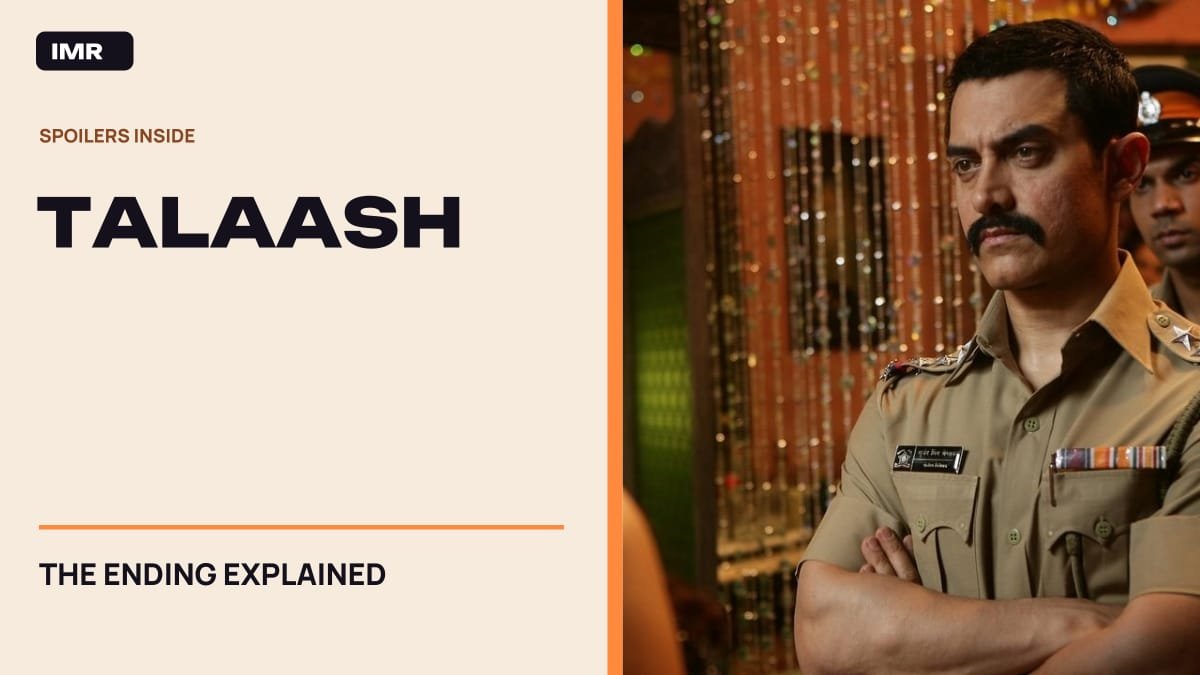
Spoiler warning: this page gives away the twist and ending of Talaash: The Answer Lies Within (2012, directed by Reema Kagti, with Aamir Khan, Rani Mukerji, Kareena Kapoor and Nawazuddin Siddiqui).
The short answer
Yes: in the film’s own logic, Rosie is a ghost. She is the spirit of Simran, an escort who was thrown out of a moving car three years earlier and left to die on the road by the actor Armaan Kapoor and his friends. Her body was hidden by the pimp Shashi.
She appears to Inspector Surjan Singh Shekhawat as “Rosie”, a street escort who becomes his informant, and she leads him to the truth. At the end she saves his life in a replay of the car accident that killed Armaan, and Surjan finds her remains and gives her a proper cremation.
The film then closes on Surjan accepting that the dead can reach the living, and reconciling with his wife Roshni.
The set-up
A famous actor, Armaan Kapoor, drives into the sea at night on a deserted road, apparently swerving to avoid something. Surjan “Suri” Shekhawat, a police inspector with insomnia and a guilt-ridden marriage after the drowning of his eight-year-old son Karan, investigates with his assistant Devrath Kulkarni.
Surjan’s wife Roshni has turned to a medium, Frenny Mistry, who says she is in touch with Karan. Surjan is angry and sceptical.
How the case unfolds
- The missing money. Armaan was carrying Rs 2 million that is now missing. He had given it to a blackmailer, a pimp called Shashi, who had covered up something for Armaan and his friend Sanjay three years earlier. Once Armaan is dead, Shashi disappears with the cash.
- The blackmail chain. Shashi’s friend Tehmur blackmails Sanjay with the help of an escort, Rosie. Sanjay has Shashi murdered.
- Rosie and Surjan. Late one night Rosie propositions Surjan. He refuses but asks if she can be an informant.
- The DVD. Police find Shashi’s body, with the money and a DVD of CCTV footage showing Armaan and his friends leaving a hotel with Rosie. She tells Surjan that three years ago she was picked up by Armaan, Sanjay and a friend named Nikhil. Nikhil has been brain-dead since that night.
- More killing. Tehmur presses Sanjay for money for his girlfriend, and Sanjay has Tehmur killed too. The police work out Sanjay was behind both deaths and arrest him.
- The confession. Sanjay admits that three years ago the three men hired an escort named Simran for Armaan’s bachelor party. A back door of the car, unlocked, flew open and threw both Nikhil and Simran out of the moving car. Armaan and Sanjay rushed Nikhil to hospital but, fearing scandal, left Simran on the road to die. Sanjay phoned Shashi to deal with her. Shashi has blackmailed them since.
- The realisation. Re-watching the DVD, Surjan sees that Simran in the footage is the woman who has been calling herself Rosie.
The ending, scene by scene
- Surjan drives Sanjay to the police station. They reach the road where Armaan crashed, and both men see Rosie/Simran standing in front of them.
- They swerve to avoid her, the same move Armaan made, and the car goes into the sea.
- Sanjay dies. Rosie saves Surjan.
- In his report Surjan calls Armaan’s death an accident.
- He returns to the riverside spot where he used to meet Rosie and finds her remains, where Shashi had hidden her body. Recalling the medium’s line that “the dead come to those who are troubled,” he cremates her properly.
- Now more open to the supernatural, he finds a letter from Karan, written down by Frenny, telling him not to blame himself and that he wants his parents to be happy. Surjan and Roshni are reconciled.
So is Rosie really a ghost?
The film plants the answer without announcing it. Rosie appears only at night, only to Surjan, and only at the moment he needs a lead. Nobody else interacts with her in a way the plot confirms, and the CCTV footage that identifies her comes from three years in the past.
When she stands in the road in the last act, both men see her, which is the one time the film shows another person seeing her. The ending’s logic is that she was a spirit seeking justice and, when it came, she saved the man who gave it. A sceptic can read it as a tormented detective’s projection, but the cremation, the remains in the place Shashi hid them, and the replay of the accident are all designed to confirm the supernatural reading.
What does the film say about grief?
There are two dead and unresolved children in the story: Surjan’s son Karan and the woman, Simran, whose death was covered up. Surjan cannot forgive himself for Karan’s drowning; the film asks him to forgive himself by giving another dead person the dignity she was denied.
His cremation of Rosie and the letter from Karan are two sides of the same release. It also explains why Surjan is the only one who can see Rosie: she appears to people who are already “troubled” in the medium’s sense.
Everyone’s fate
- Surjan: alive, reconciled with Roshni.
- Sanjay: dies in the car that goes into the sea.
- Armaan: dead in the opening car crash.
- Nikhil: brain-dead since the original accident.
- Shashi and Tehmur: murdered on Sanjay’s orders.
- Rosie/Simran: her remains are found and cremated.
Questions people keep asking
Did Rosie kill Armaan?
She did not do it directly, but his death comes from the same swerve he made to avoid her on the road. The film presents it as a haunting that repeats.
Why did the car door open?
The film treats it as an accident: an unlocked back door. What matters is that the men chose to leave Simran behind.
Was Karan’s letter real?
The letter was written by the medium, Frenny. The film leaves it open whether she is a genuine medium or comforting Surjan, but it gives him peace either way.
Who wrote it?
Reema Kagti and Zoya Akhtar developed the story and co-wrote the script. The film was released on 30 November 2012 and earned between roughly Rs 174 and 181 crore worldwide, according to Wikipedia.
See the Talaash film page for ratings and reviews.
Updates
- 5 Nov 2026 Rewritten in full: scene by scene, every character's fate, clues, fan questions and what is still unknown.
We update this page as more is confirmed.